Thromboembolism
is a hemostatic disorder associated with a cardiovascular disorder that can
cause death (1). It is characterized by the development of
thrombus or blood clots in the blood vessels, which can be dislodged, traveled
through the blood vessel, and lead to embolism or blockage of a blood vessel (2). Death caused by thromboembolism is
commonly associated with coronary artery disease, ischemic stroke related to
atrial fibrillation, and pulmonary embolism. In 1856, Virchow postulated a
triad of potential causes of thrombosis: stasis, intravascular vessel wall
injury, and hypercoagulability (3). Antithrombotic agents can prevent
thromboembolism through the inhibition of coagulation (4).
For about 70
years, warfarin has been one of the world's most prescribed anticoagulants. The
last decade has seen a significant increase in the prescription of novel direct
oral anticoagulants (DOACs) such as apixaban, rivaroxaban, dabigatran, and
edoxaban, which is associated with better safety profile and comparable
efficacy to warfarin. Nevertheless, there is still an issue that needs to be
addressed with the use of DOACs, regarding the limited choice of reversal
agents for DOACs (5), the concern of safety in some patients
with specific comorbidities (6), and the lack of standardized testing for
monitoring of DOACs (7). Although there is a constant decrease in
the use of warfarin, along with the discontinuation of the brand name Coumadin
in the USA in 2020, it remains the mainstay of anticoagulant therapy in several
countries (8, 9).
Evidence of
interindividual variations in patients’ responses to the therapy has been
observed, causing difficulty in VKAs therapy management. Inadequate coagulation
control can lead to episodes of thromboembolism or hemorrhage (10). To prevent this, therapeutic drug
monitoring (TDM) is necessary to maintain adequate anticoagulation effects.
Prothrombin time (PT) is the conventional test commonly used in therapeutic
drug monitoring for patients on VKAs therapy to predict the pharmacodynamic
effect and assess the bleeding status of patients. The standard reporting of the
PT ratio is expressed as International Normalized Ratio (INR) (). However, this test is unsuitable for
monitoring several instances, such as patient adherence, drug interaction
effect, toxicity, and drug resistance. Therefore, it is also essential to
ensure that the drug concentration in the bloodstream is appropriate, as
another method of TDM (). This can be achieved by sampling the blood
from patients through conventional or microsampling techniques and analyzing
the samples using validated bioanalytical methods.
Microsampling is
a procedure to collect minute samples (< 100 mL) from a human body for analysis in a
minimally invasive manner (13). Although it can be used for any biological
fluids, its current application is mostly limited to dried blood samples. There
has been an interest in implementing microsampling approaches due to its benefit,
which include more convenient sample collection, the ability to obtain samples
from pediatric or vulnerable subjects, and a simplified handling process (14). Dried blood spots (DBS) is the most established
microsampling approach, which has been used widely for neonatal screening since
the 1960s (15). DBS assays have been developed for many
medicines over the past decade, such as anticancer drugs (16-18), tacrolimus (19, 20), cardiovascular drugs (21), and antidiabetic drugs (22-24). These last few years also saw the development
of volumetric absorptive microsampling (VAMS). This novel dried blood sampling
approach enables more accurate and precise blood volume collection than DBS (25). Antibiotics (26), antiseizure medication (27), and paracetamol (28) were among the drugs that have been investigated
using VAMS.
We systematically reviews warfarin sampling techniques in human blood, comparing various methods and bioanalytical approaches. No prior systematic review has covered conventional and unconventional sampling techniques for bioanalysis. In this study, records were systematically selected and analyzed.
Methods
Study Protocol
The Preferred
Reporting Items for Systematical Reviews and Meta-Analysis (PRISMA) statement
is used as a guideline to conduct the literature search (29). For the search strategy, the following
descriptors were employed: “warfarin”, “therapeutic monitoring”, “human”, and “chromatography”,
using the Boolean operator. The search was conducted in ScienceDirect and
PubMed/Medline databases. The potential studies were screened according to the
inclusion and exclusion criteria without no restrictions regarding the
publication date. A manual search was also conducted using the lists of
references from the eligible articles to retrieve additional articles.
Inclusion
and Exclusion Criteria
The inclusion
criteria for this article review were: (1) Experimental and review studies
written in English, (2) Studies that explained sampling techniques and
analytical methods of warfarin and its metabolites in human blood samples using
the chromatography method.
The exclusion
criteria were (1) studies written in other languages besides English, (2)
non-related studies, (3) duplicate publications, (4) articles not available as
full-text, and (5) studies that also analyze other drugs besides warfarin.
Selection
of Studies and Data Collection
All search
results were collected and screened. All identified studies are assessed based
on the title and abstract without using any specific data extraction form. The
data are gathered independently according to the year of publication, study
design, bioanalytical method development, and clinical application to patients
or human volunteers.
Results and Discussion
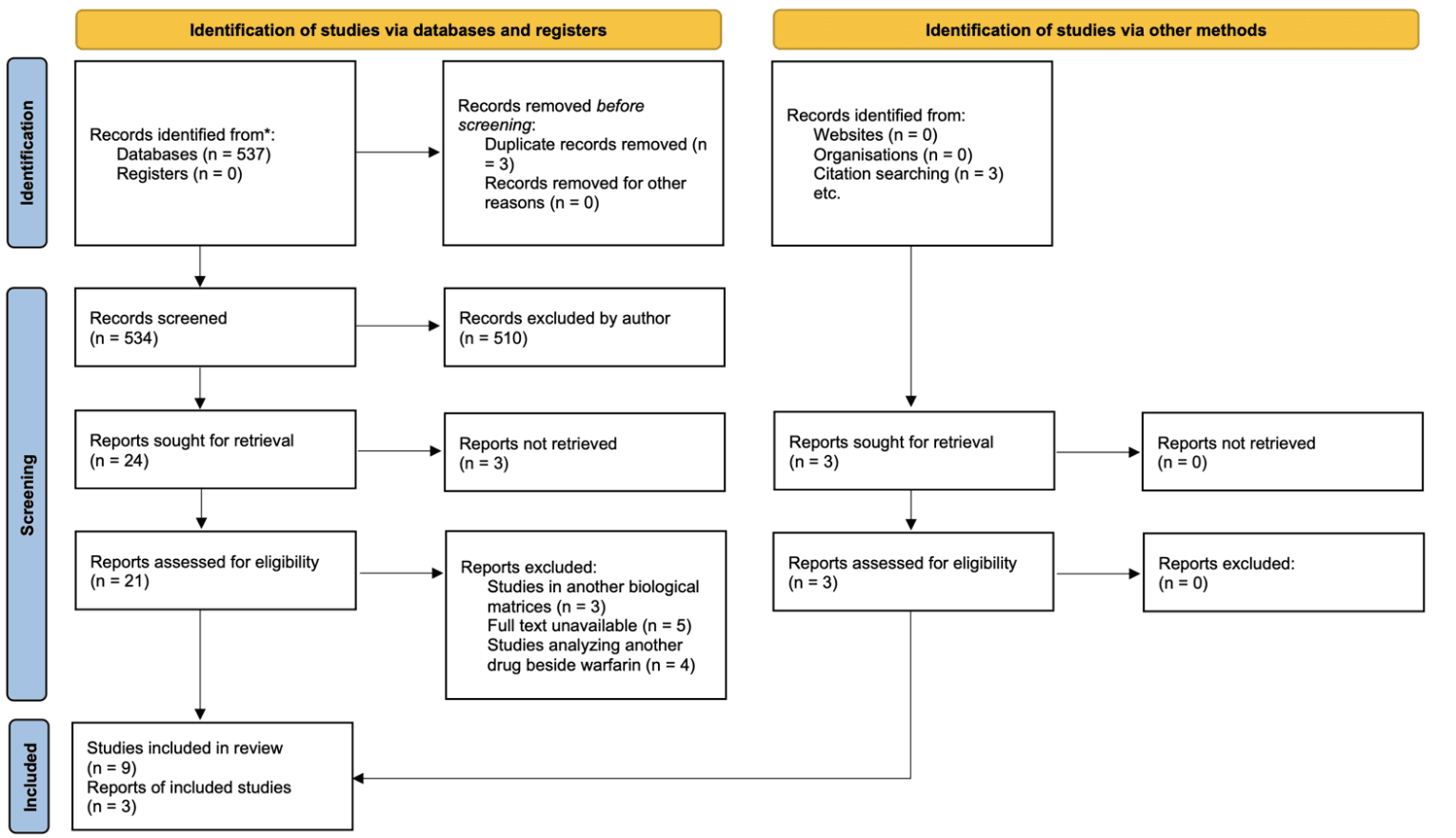
A total of 537 potentially relevant studies were identified
through database searching. The studies were screened according to the
inclusion and exclusion criteria. After the screening process, 9 articles were
identified, meeting the inclusion criteria and were considered eligible for
full review (30-38). Three articles were retrieved through
citation searching from one eligible article (39-41). We have carefully reviewed and used
those sources' data to prevent bias. Overall, we concluded that all 12 assessed
studies were considered high-quality literature because they met the inclusion
criteria and had a low risk of bias. The flowchart of the literature screening
process can be seen in Figure 1.
Anticoagulants
Hemostasis is a process the human body undergoes to prevent blood loss during a bleeding episode. The equilibrium condition is maintained between clot formation and obliteration. This process is maintained through interaction involving the cellular components, namely platelets and vascular endothelium, and the coagulation cascade and fibrinolytic system (42).
Figure 1. PRISMA flowchart of the literature search process.
A coagulation cascade is a complex model incorporating a sequential
activation of proteolytic enzymes, also known as zymogens, and the interlinking
of several pathways. The intrinsic pathway depends on contact activation by a
negatively-charged surface involving the activation of coagulation factors XII,
XI, IX, and VIII. The extrinsic pathway is started with the activation of
tissue factor (also known as factor III) during endothelial damage and the
activation of factor VII. The resulting end of these two pathways activates
factor X, which initiates the common pathway. Factor X, its cofactor (Factor
V), and calcium bind to form a prothrombinase complex, which converts
prothrombin (factor II) into thrombin (factor IIa), which in turn activate
fibrinogen (factor I) into fibrin (factor Ia), and with the help of stabilizing
factor (factor XIII) leads to the formation of fibrin crosslink to generate a
stable platelet plug/clot (43). Currently, available anticoagulants
target one of these pathways.
Warfarin
Warfarin is
the most commonly prescribed oral anticoagulant. Originally used as a rodenticide,
warfarin was accepted for medical use in 1954 under the brandoumadin (44). Warfarin is a vitamin K antagonist that
exerts its effect by competitively inhibiting vitamin K epoxide reductase
(VKOR), an enzyme essential for converting vitamin K into an active form. As a
cofactor in the activation of coagulation factors II, VII, IX, and X, as well
as the coagulation regulatory factors Protein C and S (45),
the decrease in activated vitamin K levels can reduce the synthesis of these
proteins.
Warfarin is
administered as a racemic mixture of R-warfarin and S-warfarin. Warfarin has a
half-life of 36 to 42 hours and reaches maximum blood concentration 90 minutes
after administration (46).
Warfarin is extensively metabolized in the liver, mainly by CYP2C9, and each
isomer undergoes a different pathway (47). Intra- and inter-individual variability
has been observed during warfarin therapy, causing difficulty in determining
the dose regimen for patients. In addition, warfarin also exhibits a narrow
therapeutic index. Subtherapeutic and supratherapeutic warfarin dosages may
lead to fatal adverse events (48). Patients receiving warfarin are at
greater risk for bleeding, and exceeding the therapeutic index may lead to
significant hemorrhage. Patients receiving warfarin should be closely monitored
to prevent this adverse effect, and the dosage should be tailored accordingly.
International Normalized Ratio (INR) is the standard laboratory parameter used
to monitor anticoagulant therapy to ensure the safety and efficacy of the
therapy (10).
Warfarin is a
narrow therapeutic index drug that requires constant monitoring. Typical
therapeutic drug monitoring (TDM) requires measuring pharmacokinetic or
pharmacodynamic parameters. Selecting a specific pharmacokinetic or
pharmacodynamic assay depends on intersubject variability (49). In the case of warfarin, the high
variability of pharmacodynamic response necessitates using INR value to monitor
the therapy's efficacy and aid the dose adjustment process(50). However, assessment of warfarin
concentration in the bloodstream may be beneficial in some clinical situations
where sudden and unexpected changes in INR value or patient’s response of
unknown origin are observed. In cases such as drug interaction, the measurement
of warfarin blood levels may help the physician decide if the increase or
decrease of warfarin concentration corresponds to the history of medication and
food recently taken by the patient. Warfarin blood levels can also be used to diagnose
warfarin intoxication. Warfarin blood level could also be useful in determining
patient adherence. Adherence is a major issue with long-term medication regimens
(51), particularly requiring constant monitoring,
such as warfarin. Self-report results can be unreliable at times, but analysis
of warfarin blood level could confirm the result, allowing the physician to
take measures to improve patient adherence and increase the therapy's efficacy.
This analysis can further differentiate between adherence and resistance,
correlating warfarin level to the patient’s response. Resistance can be
attributed to acquired factors (drug interaction, non-compliance) or hereditary
factors such as genetic polymorphism (52). Measuring the genotype of enzyme
polymorphism and phenotype (warfarin and its metabolites concentration) may
help the physician assign the patient's metabolizer status (fast, intermediate,
poor) and design the algorithm to determine the optimal dose for patients to
achieve better efficacy.
Table 1. Summary of the results from the literature review.
Nevertheless, the measurement of warfarin concentration in the
blood is seldom used in monitoring. This is possibly caused by the lack of
available assays to measure warfarin in blood samples. Developing a bioanalytical
method to analyze warfarin in biological samples will enable the use of warfarin
blood concentration for monitoring in a routine clinical setting. The method
included in this review covered several bioanalytical methods to analyze
warfarin in human blood samples.
Blood Sampling Technique
Blood samples from patients or healthy volunteers can be
obtained through conventional or micro sampling. The Conventional method is
commonly used to collect liquid blood samples such as whole blood, plasma, and
serum. Although effective, this method is considered invasive and may be
uncomfortable for patients. This leads to the development of a microsampling
approach, characterized by a collection of smaller blood volume, which is then
stored as dried samples. Dried blood spots (DBS) and volumetric absorptive
microsampling (VAMS) are the two methods extensively investigated for clinical
application as an alternative to conventional sampling. Table 1 explains
samples and sampling techniques used to measure warfarin concentration
described in the eligible studies.
Conventional Blood Sampling
The collection
of blood samples by phlebotomy is the most common type of biological specimen
collection (53).
The blood is usually obtained from the median cubital vein in the upper arm,
near the radial cutaneous vein. Tourniquet is applied to the arm, and the area
will be cleansed with alcohol. Patients are asked to close their hands. After
the alcohol has dried, venipuncture is performed with a suitable needle, and
once the blood flow begins, patients will be requested to open their hands, the
tourniquet released, and the blood will be collected using a tube (54). This method can be applied for plasma and
serum sampling, which differs from the sample collection tube. The tube for
plasma collection contains an anticoagulant, and the serum tube does not. This
method is invasive and may lead to a low recruitment rate in clinical trials,
especially pediatric patients. The quality of the phlebotomy will also directly
affect the quality of the sample and the analysis result (55). In this review, ten studies have been
described to use convenience sampling to analyze human plasma, and 1 study used
convenience sampling to analyze serum.
Microsampling
Dried Blood Spots (DBS)
Traditionally
used as a neonatal screening sampling method, dried blood spot (DBS) has gained
attention as a tool for pharmacokinetic and toxicokinetic studies (56). The first recorded use of DBS was in the early
1960s when Robert Guthrie introduced this method for phenylketonuria screening
in newborns using heel prick (15, 57). The blood can be obtained from finger
pricks in pediatric and adult patients. The drop of blood is applied to the
filter paper, which is then dried for about 2 to 3 hours. The spot is punched
after the blood dries for 2 to 3 hours. It can be directly analyzed using suitable
analytical techniques or stored and transported to an analytical laboratory
before analysis. This method has been developed for other biological matrixes,
such as plasma and urine, which are obtained similarly to DBS (58). The limitation of this method is related
to the hematocrit (HCT) effect and homogeneity of the area, which may cause
bias in the analysis. Although DBS assays have
been developed for many medicines over the past decade, such as anticancer
drugs (16-18), tacrolimus (19, 20), cardiovascular drugs (21), and antidiabetic drugs (22-24), the author only found 1 study that
described the use of DBS for analysis in patients receiving warfarin therapy (59).
Volumetric Absorptive Microsampling
Volumetric
Absorptive Microsampling (VAMS) is a method involving the absorption of a
liquid sample into a substrate. The device comprises a plastic handler with a
hydrophilic porous substrate on the tip (60). The sampling procedure is similar to DBS,
in which blood can be directly applied to the tip and dried before being stored
or transported for analysis. The volume of the sample absorbed depends on the
properties and the amount of substrate, but unlike DBS, VAMS allowed the sample
to be measured quantitatively. Another advantage of VAMS is that it can limit
the hematocrit effect usually found on DBS samples, leading to different spot
sizes on the paper and nonhomogeneity (61).
The author finds no article related to using VAMS in the bioanalysis of
warfarin.
Bioanalytical Method Development and Validation
Bioanalytical method development aims to define the design,
operating conditions, limitations, and suitability of the method for its
intended purpose and to ensure that it is optimized for validation. Before
developing a bioanalytical method, a complete understanding of the analyte’s
properties must be achieved. This includes physicochemical properties, in vitro
and in vivo metabolism, protein binding, stability, and other properties that
could affect the analytical method. Previous analytical methods already
reported could be considered to design a suitable method.
Optimization of the method involves the condition and
procedures related to analyte extraction and detection. During this phase,
several conditions could be tested, such as the choice and concentration of
extraction solvent, flow rate, and detection wavelength, to obtain the optimal
bioanalytical method (62).
Bioanalytical Method Validation
Bioanalytical method validation is done to ensure the
performance of the optimized method. Validation is usually performed according
to guidelines from European Medicines Agency (EMA) (63) or the Food and Drug Administration (FDA) (64). The parameters tested in the validation
are listed below:
Selectivity
Selectivity is done to verify that the analytical method can
differentiate analyte and internal standard from interference or other
components in the sample. Selectivity testing is done by analyzing six
individual sources of a blank matrix. The acceptance criteria for selectivity
is that the responses from the blank sample are less than 20% from the LLOQ
analyte and less than 5% for internal standards (63, 64).
Carry-over
Carry-over has to be detected and minimized in analysis.
Carry-over testing is done by injecting a blank sample after the high-concentration
sample, calibration standard, or the upper limit of quantification (ULOQ). The
acceptance criteria for carry-over is the percentage of carry-over should not
exceed 20% of LLOQ. If carry-over cannot be avoided, the sample should not be
chosen randomly, and the carry-over effect must be monitored throughout the
analysis (63, 64).
Lower Limit of Quantitation (LLOQ)
The lower limit of quantification (LLOQ) is the lowest
concentration value of the analyte that can still be calculated accurately and
precisely. LLOQ defines the method's sensitivity and should be determined
during method development. The LLOQ value of the sample must be five times
greater than the blank and not higher than 5% Cmax (63, 64).
Calibration Curve
The calibration curve is the range of concentrations needed
to analyze a sample according to the instrument's response. The quantitation
range of the analytical method should be established during the method
development. The calibration curve must contain at least a blank sample, zero
sample (blank + IS), and six concentration levels, including ULOQ as the
highest point and LLOQ as the lowest point of the quantitation range. The
calibration curve must be reproducible and continuous. A calibration curve must
be generated for each analyte if there is more than one analyte. The measured
concentration must be within 15% of the actual concentration, except for LLOQ, which
should be within 20%. At least 75% of calibration standards must meet these
criteria in each run (63, 64).
Accuracy and Precision
Accuracy describes the closeness of the obtained
concentration from the analysis with the actual concentration value, expressed
in percentage. Precision describes the repeatability of the analyte measurement
and is expressed as a coefficient of variation (CV). Accuracy and precision are
analyzed using quality control (QC) samples in four concentrations, namely the
LLOQ, QCL (three times the LLOQ), QCM (30–50% of calibration curve range), and
QCH (75% of the ULOQ). Accuracy and precision must be done in at least five
replicates: within-run (single run) and between-run (at least three runs in two
days). The acceptance criteria for accuracy is that the concentration must be
within 15% of the actual concentration, except for the LLOQ (within 20%). The
acceptance criteria for precision validation is the CV must not exceed 15% for the
QC sample and 20% for the LLOQ (63, 64).
Dilution Integrity
Dilution of samples should not affect accuracy and
precision. Dilution integrity testing is done by spiking the matrix with the analyte
concentration above the upper limit of quantification (ULOQ), which then
dilutes with the blank matrix. The analysis is done in five replicates for each
dilution factor. The acceptance criteria are that the accuracy and precision
value must be within 15% (63, 64).
Matrix Effect
The matrix effect is investigated when using mass
spectrometry to investigate the effect of ion suppression or ion enhancement on
the concentration of the analyte. Matrix effects are tested using a minimum of
6 blank matrixes from 6 individual sources. The matrix factor of the analyte
and the internal standard is calculated from the peak area of a spiked matrix
with the peak area of the analyte in the standard solution. The testing must be
conducted at low and high concentrations (maximum three times LLOQ and close to
ULOQ). The acceptance requirement is the CV should not exceed 15% (63, 64).
Stability
Stability testing is carried out to ensure that the process
of preparation, analysis, and storage conditions of samples does not affect the
concentration of the analyte. Stability must be ensured at every stage of the
analytical method. Stability is evaluated using QCL and QCH, which are analyzed
immediately after preparation and applied storage conditions. A calibration
curve is used for the stability test of QC samples by comparing the obtained
concentration with the analyte concentration. The acceptance criteria are that
the %diff for each concentration level must not exceed 15%.
The stability condition that must be evaluated is as follows:
Stability of the stock solution, working solutions, and internal standard
Freeze and thaw stability of the analyte on the matrix
Short-term stability of the analyte at room temperature or analysis temperature
Long-term stability of the analyte under storage conditions in the freezer
In addition, the following tests could be done if applicable:
Stability of the sample at room temperature or storage conditions during analysis
Bench-top stability
Autosampler stability (63,64).
Most of the studies included in this systematic review have described a full validation of the analytical method. Lv et al. performed validation according to China Pharmacopoeia alongside FDA guidelines. Ghimenti et al. and Lomonaco et al. performed validation according to the IUPAC guideline (65). Because some of the studies were conducted before the publication of FDA guidelines in 2018, validation was conducted according to the guidelines then. Nevertheless, these studies have described a satisfactory validation result. One study only described a standard curve (66). Still, owing to the outdated year of the publication, a method validation guideline had not been established at that time. Two studies did not describe validation, primarily because the studies are developing a novel microextraction method using warfarin as the model drug (32, 67).
Table 2. Summary of extraction protocol from the literature review.
Extraction Protocol
Ref(s)
0.2 mL plasma + 20 µL IS + 150 µL 1 N
sulfuric acid and 1.0 mL ethyl ether into a 96-well plate. The mixture was
vortexed for 10 min, then centrifuged at 5200 rpm for 3 mins. 0.4 mL ether
supernatant transferred and evaporated to dryness, reconstituted with 0.2 mL
methanol.
250 µL plasma + 0,2 mL NaOH 1 M + 4.0
mL ether. The mixture was vortexed for 30 s and centrifuged. Aqueous phase
acidified with 0.5 mL HCl 2 M + ether 4 mL containing warfarin
and
warfarin alcohol
, vortexed for 30 s and centrifuged. The ether
extract was evaporated and derivatized with an ether solution of
diazomethane.
DBS disk + 500 µL
methanol-acetonitrile (3:1 v/v). The mixture was vortexed for 1 min and
centrifuged at 5.000 rpm for 5 mins. 200 µL supernatant was diluted five
folds with 0.1% formic acid.
LDH-MMM bent into a U shape, injected
with 25 µL DES and immersed into the sample. Extraction was done for 30 mins
with a magnetic stirrer at 1500 rpm. Extraction solvent was collected, and 25
µL desorption solvent (acetonitrile) was injected into the LDH-MMM.
Extraction and desorption solvent was combined and injected into the HPLC
system
50 µL plasma, spiked with IS. Ice-cold
0.2% formic acid (190 µL) + ice-cold 0.2% formic acid in acetonitrile (1000
µL) were added. Samples were precipitated at 4°C for 30 mins and then
centrifuged. 1000 µL supernatant was dried and reconstituted in the mobile
phase.
50 µL plasma + 190 µL methanol-water
(7:1 v/v) containing 30 nM IS. Vortexed 10 s, centrifuged 225 g 15 mins.
Supernatants were evaporated under nitrogen for 45 mins and reconstituted
with 100 µL methanol-water (15:85 v/v)
1 ml plasma + 10 µL IS. After column
conditioning with 1% methanol pH 2.8, the analyte and IS were eluted from the
C18 column using 2 ml acetonitrile. The organic phase was evaporated under
nitrogen gas. Reconstituted with 200 µL water.
500 µL plasma + 2 ml H2SO4
0.5 M + 500 µL ethanol + 4 mL dichloromethane-hexane (1:5 v/v). The mixture
was vortexed for 30 s and centrifuged at 5000 rpm for 5 mins. The organic
phase evaporated, and the residue was reconstituted in 1 mL PBS 25 mM.
45 µL plasma + 5 µL IS + 5 µL
methanol, vortexed 10 s.150 µL acetonitrile was added, vortexed for 3 mins
and centrifuged 10 mins at 14.000 rpm. 20 µL supernatant diluted with 380 µL
mobile phase.
60 µL hydrophobic DES
(borneol:decanoic acid 1:3) was added to the sample. The mixture was
repeatedly pulled and pushed into the extraction vessel 15 times with a 2 mL
glass syringe. The mixture was centrifuged at 6000 rpm for 10 mins to
separate the DES-rich phase.
200 µL plasma + 20 µL IS, vortexed 10
s. 800 µL acetonitrile was added and vortexed for 1 min, centrifuged at 20.000
rpm for 5 mins. The supernatant was evaporated under a nitrogen stream and
reconstituted in 100 µL mobile phase, vortexed 1 min and centrifuged at 3000
rpm for 5 mins.
MAX cartridge conditioned with 2 mL
methanol, followed by 2 mL water. 250 µL plasma + 2.5 µL IS + 250 µL 10%
perchloric acid/ 4% phosphoric acid, vortexed 30 s, centrifuged 10 mins at
1000 rpm. 450 µL supernatant loaded on the cartridge, washed with 2% NH4OH
and 2 mL of water. Analytes were eluted with 2 mL
acetonitrile-methanol-formic acid (50:50:5 v/v/v). Eluent was collected,
evaporated, and reconstituted with 50 µLacetonitrile-water (40:60 v/v).
Note: DES: deep eutectic solvent, IS:
internal standard, LDH-MMM: layered double hydroxides mixed matrix membrane;
PBS: phosphate buffer saline.
Sample Preparation
Sample preparation is vital in bioanalysis, extracting analytes from matrices to eliminate interference and prevent column blockage. The chosen method must maintain sample integrity, ensuring accurate in vivo concentration representation (68). Table 2 summarizes the sample preparation process in each article.
Commonly used extraction method includes protein
precipitation (PPT), liquid-liquid extraction (LLE), and solid phase extraction
(SPE). LLE is mainly used to extract enantiomer warfarin and its metabolites,
usually using organic phase alkyl ether such as methyl tert-butyl ether and
aqueous phase. PPT is also favorable because of the high recovery and ability
to remove protein components in plasma or blood samples. Water-miscible organic
solvents and acids are the most commonly used solvent for PPT (69). The disadvantage of PPT is that it may
increase the chromatography system's back pressure because soluble plasma
contents are bound to the column's stationary phase (68). SPE used a sorbent material in a
cartridge device to separate various sample components based on their
physicochemical properties. The analyte or impurity from the sample is eluted
from the cartridge using suitable solvents. This method is very effective and applicable
to a wide range of matrices. It demonstrates high recovery and requires minimum
pretreatment (70), but the technique is more complex and costly than LLE or
PPT. LLE or PPT is more cost-effective, but the process is more laborious and
warrants the high usage of organic solvent, producing more toxic waste. Recent
advances in sample preparation are aimed toward green chemistry, with the
development of the microextraction method and the usage of a sustainable
natural solvent such as deep eutectic solvents as described in the studies done
by Jafari et al. and Majidi et al. (32, 33).
These studies could lead to reduced analysis costs, a more efficient extraction
process, and a more environmental-friendly method.
According to the literature review from 12 studies, the bioanalytical
method has been developed to study the concentration of warfarin in human blood
samples such as plasma, serum, and DBS. The concentration of warfarin in the clinical
application was well within the calibration range. Most of the studies use
LC-MS/MS, which leads to higher sensitivity and selectivity of analysis. But in
conditions where the LC-MS/MS method cannot be applied because of the high
operational cost and the unavailability of a skilled operator, HPLC can be used
as a substitute (71, 72).
Clinical Application of Warfarin Bioanalytical Method
Analysis of plasma from healthy volunteers or patients
receiving warfarin therapy has been conducted for several purposes, such as
pharmacokinetic study (41). This is particularly useful for assessing
the absorption, distribution, metabolism, and excretion of the drug in the body
and is largely used in bioequivalence studies. Another study used plasma
samples to conduct a drug interaction study (30, 40). By analyzing the pharmacokinetics of a
drug after co-administration with another drug, herbal supplement, or food, a
relationship can be determined, whether the co-administration causes inhibition
or induction of the related metabolizing enzyme, which may result in altered
pharmacodynamics. Four studies used plasma (35-38), and one study has also been found to
use patients’ serum to perform metabolic profiling of warfarin (34). With its wide variabilities in
dose-response relationships and multiple drug interactions, warfarin remains
one of the top ten drug-related causes of serious adverse drug events. Analysis
of warfarin and its metabolites in blood samples will provide a better
understanding of warfarin metabolism, which largely involves cytochrome P450.
Further studies regarding the polymorphism of CYP enzymes associated with
warfarin metabolic conversion will allow physicians to adjust dosage
accordingly.
Few studies still use the microsampling method for
quantifying warfarin in blood samples. Several studies have applied DBS in
studies using laboratory animals, but the author only found one study that used
DBS to analyze warfarin levels in human patients (39). The article also described an attempt to
evaluate the correlation between DBS and plasma sample concentration. The
result showed a good correlation with correlation coefficients r ≥ 0.95,
demonstrating the applicability of DBS sampling as an alternative to plasma for
measuring warfarin concentration in the bloodstream.
The microsampling method offers more advantages than the conventional
sampling method. It is minimally invasive, which benefits patients subject to
frequent blood tests for monitoring during therapy. Microsampling can also be
useful in pharmacokinetic and bioequivalence tests, in which blood was
collected for several points (12-18 times) over time. In the case of warfarin, which
must be monitored constantly for the duration of the therapy, the microsampling
method may be beneficial and more convenient to the patient. When the patients cannot
go to the laboratory, they can collect the sample alone. The technique is
simpler, and some analytes in the dried blood samples, such as DBS and VAMS,
tend to be more stable than other biosampling techniques (73). Most DBS and VAMS studies showed that the
samples were stable in room temperatures, easing the process of sample
transportation and storage compared to plasma samples that must be stored at -20ºC.
One analytical method for human DBS samples of warfarin has been demonstrated
to meet the validation criteria, with intra- and inter-day precision variation resulting
in lower than 10% and accuracy within 96-103% of the real concentration (39). In addition, the method was successfully applied
in vivo to patients receiving warfarin, and upon comparison with plasma
samples, a good correlation was described between DBS and plasma samples, demonstrating
that the DBS method is suitable to substitute plasma samples. The author
finds no article related to using VAMS in the bioanalysis of warfarin. This
indicated that using VAMS as a sampling means for therapeutic drug monitoring
(TDM) has not been explored yet and highlights potential for future
development.
Conclusion
This systematic
review summarizes sampling techniques to quantify warfarin in human blood
samples and the bioanalytical method used to analyze the samples. The authors
found no systematic review comparing conventional and unconventional sampling
techniques for bioanalytical purposes thus far.
Several bioanalytical methods have been employed to perform
analysis of warfarin in blood samples through the means of conventional
sampling and micro sampling. The conventional sampling method is primarily used
to obtain plasma samples from patients or healthy volunteers but is considered
invasive. Microsampling offers simpler and less invasive methods, enhances the
stability of the analyte, and easier sample handling for storage or
transportation before analysis. However, the literature describing
microsampling, namely DBS, has been limited compared to the plasma analysis. In
addition, the author found no literature that mentions volumetric absorptive
microsampling (VAMS) for analysis of warfarin.
In the last few years, bioanalysis has seen increased
interest in using microsampling as a routine sampling technique in clinical
settings. While the authors only found one study that included the comparison
of microsampling to a conventional approach using plasma samples, the results
showed comparable pharmacokinetic data, further underlining the possibility of microsampling
as a substitute for conventional blood sampling. Ongoing investigations in
microsampling bioanalysis are important to improve confidence in using
microsampling techniques to support clinical research before introducing
microsampling as a routine procedure for therapeutic drug monitoring of
warfarin.
Abbreviations
CV: coefficient of variation; LLOQ: Lower limit of quantification; QCL: Quality control low; QCM: Quality control medium; QCH: Quality control high; ULOQ: Upper limit of quantification; GC-MS: gas chromatography-mass spectrometry; HPLC: high-performance liquid chromatography; LC-MS/MS: liquid chromatography-tandem mass spectrometry; MEKC-MS/MS: micellar electrokinetic chromatography-tandem mass spectrometry; SFC-MS/MS: supercritical fluid chromatography-tandem mass spectrometry; ALLME: air-assisted liquid-liquid microextraction; LLE: liquid-liquid extraction; LLSMME: liquid-liquid solid membrane microextraction; PPT: protein precipitation; SPE: solid phase extraction; UF: ultrafiltration; VAMS: volumetric absorptive microsampling.
Warfarin is a vitamin K antagonist (VKAs) anticoagulant associated with interindividual patients’ response to therapy, narrow therapeutic index, and serious adverse drug events. Monitoring ensures efficacy and safety by measuring drug concentration in the bloodstream, which demands blood or plasma samples from patients through conventional sampling. Conventional sampling often requires invasive methods that may be uncomfortable for patients. Microsampling offers an opportunity to reduce the burden of multiple blood sampling on patients and simplifies the process of sample transportation and storage. This systematic review describes conventional and microsampling techniques for quantifying warfarin in human blood samples and the bioanalytical method employed to perform the analysis. Related studies (537) were screened from several databases and narrowed down into 12 eligible articles, which were then used to fulfill the purpose of this review in a narrative form. It is concluded that while there are still limited studies regarding the application of microsampling for warfarin quantification in patients, there has been evidence of comparable plasma and micro samples results, highlighting the potential for future development of routine monitoring using the microsampling technique.
Kumar V, Abbas
AK, Aster JC, Robbins SL. Robbins Basic Pathology. Elsevier/Saunders; 2013.
(ClinicalKey 2012).
Pastori D,
Cormaci VM, Marucci S, Franchino G, Del Sole F, Capozza A, et al. A
Comprehensive Review of Risk Factors for Venous Thromboembolism: From
Epidemiology to Pathophysiology. Vol. 24, International Journal of Molecular
Sciences. MDPI; 2023.
Esmon CT. Basic
mechanisms and pathogenesis of venous thrombosis. Blood Rev. 2009
Sep;23(5):225–9.
Floyd CN.
Indications for anticoagulant and antiplatelet combined therapy. BMJ.
2017;359:1–5.
Cuker A, Burnett
A, Triller D, Crowther M, Ansell J, Van Cott EM, et al. Reversal of direct oral
anticoagulants: Guidance from the Anticoagulation Forum. Am J Hematol.
2019;94(6):697–709.
Wadsworth D,
Sullivan E, Jacky T, Sprague T, Feinman H, Kim J. A review of indications and
comorbidities in which warfarin may be the preferred oral anticoagulant. J Clin
Pharm Ther. 2021;46(3):560–70.
Franchini M,
Liumbruno GM, Bonfanti C, Lippi G. The evolution of anticoagulant therapy.
Blood Transfusion. 2016;14(2):175–84.
Chong HJ,
Masaharu A, Alvaro A, Gerald B, Shun K, Deirdre L, et al. WORLDWIDE ORAL
ANTICOAGULANT PRESCRIPTION PREVALENCE AND TRENDS IN PATIENTS WITH ATRIAL
FIBRILLATION FROM A MULTI-NATIONAL COHORT: INSIGHTS FROM THE INTERNATIONAL
COLLABORATIVE PARTNERSHIP FOR THE STUDY OF ATRIAL FIBRILLATION (INTERAF)
COLLABORATIVE. J Am Coll Cardiol. 2019 Mar 12;73(9_Supplement_1):376.
Zhang C, Wang J,
Yang Y, Ma EL, Lin HW, Liu BL, et al. Prescribing Trends of Oral Anticoagulants
from 2010 to 2020 in Shanghai, China: A Retrospective Study. Clinical and
Applied Thrombosis/Hemostasis. 2022;28:1–10.
Kwon MJ, Kim HJ,
Kim JW, Lee KH, Sohn KH, Cho HJ, et al. Determination of plasma warfarin
concentrations in Korean patients and its potential for clinical application. Korean
Journal of Laboratory Medicine. 2009;29(6):515–23.
Costa IM, Soares
PJ, Afonso M, Ratado P, Lanao JM, Falcão AC. Therapeutic Monitoring of
Warfarin: the Appropriate Response Marker. Journal of Pharmacy and
Pharmacology. 2010;52(11):1405–10.
Sun S, Wang M, Su
L, Li J, Li H, Gu D. Study on warfarin plasma concentration and its correlation
with international normalized ratio. J Pharm Biomed Anal. 2006;42(2):218–22.
Lei BUW, Prow TW.
A review of microsampling techniques and their social impact. Biomed
Microdevices. 2019 Dec 1;21(4):1–30.
Spooner N,
Anderson KD, Siple J, Wickremsinhe ER, Xu Y, Lee M. Microsampling:
Considerations for its use in pharmaceutical drug discovery and development.
Bioanalysis. 2019;11(10):1015–38.
Guthrie R.
Screening for phenylketonuria. Triangle. 1969;9(3):104–9.
Harahap Y,
Manggadani BP, Sitorus TRJ, Mulyadi CA, Purwanto DJ. Clinical application of
dried blood spot for monitoring studies of tamoxifen, endoxifen, and
4-hydroxytamoxifen in breast cancer patient using liquid chromatography–tandem
mass spectrometry. International Journal of Applied Pharmaceutics. 2019 Mar
1;11(2):59–63.
Poetto AS,
Posocco B, Gagno S, Orleni M, Zanchetta M, Iacuzzi V, et al. A new dried blood
spot LC-MS/MS method for therapeutic drug monitoring of palbociclib,
ribociclib, and letrozole in patients with cancer. Journal of Chromatography B.
2021 Nov;1185:122985.
Andriguetti NB,
Hahn RZ, Lizot LF, Raymundo S, Costa JL, da Cunha KF, et al. Analytical and
clinical validation of a dried blood spot assay for the determination of
paclitaxel using high-performance liquid chromatography-tandem mass
spectrometry. Clin Biochem. 2018 Apr;54:123–30.
Zwart TC, Gokoel
SRM, van der Boog PJM, de Fijter JW, Kweekel DM, Swen JJ, et al. Therapeutic
drug monitoring of tacrolimus and mycophenolic acid in outpatient renal
transplant recipients using a volumetric dried blood spot sampling device. Br J
Clin Pharmacol. 2018 Dec 1;84(12):2889–902.
Hoogtanders K,
Van Der Heijden J, Christiaans M, Van De Plas A, Van Hooff J, Stolk L. Dried
blood spot measurement of tacrolimus is promising for patient monitoring.
Transplantation. 2007 Jan;83(2):237–8.
Kim HM, Park JH,
Long NP, Kim DD, Kwon SW. Simultaneous determination of cardiovascular drugs in
dried blood spot by liquid chromatography-tandem mass spectrometry. J Food Drug
Anal. 2019 Oct 1;27(4):906–14.
AbuRuz S, Millership
J, McElnay J. Dried blood spot liquid chromatography assay for therapeutic drug
monitoring of metformin. J Chromatogr B Analyt Technol Biomed Life Sci.
2006;832(2):202–7.
Scherf-Clavel M,
Högger P. Analysis of metformin, sitagliptin and creatinine in human dried
blood spots. J Chromatogr B Analyt Technol Biomed Life Sci [Internet].
2015;997:218–28. Available from:
http://dx.doi.org/10.1016/j.jchromb.2015.06.014
Swales JG,
Gallagher RT, Denn M, Peter RM. Simultaneous quantitation of metformin and
sitagliptin from mouse and human dried blood spots using laser diode thermal
desorption tandem mass spectrometry. J Pharm Biomed Anal [Internet].
2011;55(3):544–51. Available from: http://dx.doi.org/10.1016/j.jpba.2011.02.030
Londhe V, Rajadhyaksha
M. Opportunities and obstacles for microsampling techniques in bioanalysis:
Special focus on DBS and VAMS. J Pharm Biomed Anal [Internet]. 2020;182:113102.
Available from: https://doi.org/10.1016/j.jpba.2020.113102
Moorthy GS, Vedar
C, Zane NR, Downes KJ, Prodell JL, DiLiberto MA, et al. Development and
validation of a volumetric absorptive microsampling- liquid chromatography mass
spectrometry method for the analysis of cefepime in human whole blood:
Application to pediatric pharmacokinetic study. J Pharm Biomed Anal [Internet].
2020;179(June):113002. Available from:
https://doi.org/10.1016/j.jpba.2019.113002
D’urso A,
Locatelli M, Tartaglia A, Molteni L, D’ovidio C, Savini F, et al. Therapeutic
drug monitoring of antiseizure medications using volumetric absorptive
microsampling: Where are we? Pharmaceuticals. 2021;14(7):1–15.
Delahaye L,
Baerdemaeker L De, Stove CP. Determination of paracetamol and its metabolites
via LC-MS/MS in dried blood volumetric absorptive microsamples: a tool for
pharmacokinetic studies. J Pharm Biomed Anal [Internet]. 2021;206:114361.
Available from: https://doi.org/10.1016/j.jpba.2021.114361
Page MJ, McKenzie
JE, Bossuyt PM, Boutron I, Hoffmann TC, Mulrow CD, et al. The PRISMA 2020
statement: An updated guideline for reporting systematic reviews. The BMJ.
2021;372.
Coe RA, Rathe JO,
Lee JW. Supercritical fluid chromatography-tandem mass spectrometry for fast
bioanalysis of R/S-warfarin in human plasma. J Pharm Biomed Anal.
2006;42(5):573–80.
Duffield AM,
Duffield PH, Birkett DJ, Kennedy M, Wade DN. Plasma quantitation of warfarin
and warfarin alcohol by gas chromatography chemical ionization mass
spectrometry in patients on warfarin maintenance therapy. Biol Mass Spectrom.
1979;6(5):208–11.
Jafari Z, Reza
Hadjmohammadi M. Enhancing enrichment ability of Co-Al- layered double
hydroxides-mixed matrix membrane microextraction by deep eutectic solvent for
analysis of warfarin in biological samples and its quantification via
high-performance liquid chromatography-ultraviolet de. Microchemical Journal.
2022;175(107167):1–10.
Majidi SM,
Hadjmohammadi MR. Hydrophobic borneol-based natural deep eutectic solvents as a
green extraction media for air-assisted liquid-liquid micro-extraction of
warfarin in biological samples. J Chromatogr A [Internet].
2020;1621(461030):1–9. Available from:
https://www.sciencedirect.com/science/article/pii/S0021967320302466
Wang X, Hou J,
Jann M, Hon YY, Shamsi SA. Development of a chiral micellar electrokinetic chromatography–tandem
mass spectrometry assay for simultaneous analysis of warfarin and
hydroxywarfarin metabolites: Application to the analysis of patients serum
samples. J Chromatogr A [Internet]. 2013;1271(1):207–16. Available from:
https://www.sciencedirect.com/science/article/pii/S0021967312017797
Lomonaco T,
Ghimenti S, Piga I, Onor M, Melai B, Fuoco R, et al. Determination of total and
unbound warfarin and warfarin alcohols in human plasma by high performance
liquid chromatography with fluorescence detection. J Chromatogr A [Internet].
2013;1314:54–62. Available from:
https://www.sciencedirect.com/science/article/pii/S0021967313013770
Jones DR, Boysen
G, Miller GP. Novel multi-mode ultra performance liquid chromatography–tandem
mass spectrometry assay for profiling enantiomeric hydroxywarfarins and
warfarin in human plasma. Journal of Chromatography B [Internet].
2011;879(15):1056–62. Available from:
https://www.sciencedirect.com/science/article/pii/S1570023211001759
Ju W, Peng K,
Yang S, Sun H, Sampson M, Wang MZ. A chiral HPLC-MS/MS method for simultaneous
quantification of warfarin enantiomers and its major hydroxylation metabolites
of CYP2C9 and CYP3A4 in human plasma. Austin J Anal Pharm Chem. 2014;1(2):1–8.
Kumar DK, Shewade
DG, Parasuraman S, Rajan S, Balachander J, Chandran BVS, et al. Estimation of
plasma levels of warfarin and 7-hydroxy warfarin by high performance liquid
chromatography in patients receiving warfarin therapy. Journal of Young
Pharmacists [Internet]. 2013;5(1):13–7. Available from:
http://dx.doi.org/10.1016/j.jyp.2013.02.001
Ghimenti S,
Lomonaco T, Biagini D, Bellagambi FG, Onor M, Trivella MG, et al. Determination
of warfarin and warfarin alcohols in dried blood spots by ultra-high
performance liquid chromatography coupled to electrospray ionization-tandem
mass spectrometry (UHPLC-ESI-MS/MS). Microchemical Journal [Internet].
2018;136:247–54. Available from: https://doi.org/10.1016/j.microc.2017.03.057
Lv C, Liu C, Liu
J, Li Z, Du X, Li Y, et al. The Effect of Compound Danshen Dripping Pills on
the Dose and Concentration of Warfarin in Patients with Various Genetic
Polymorphisms. Clin Ther [Internet]. 2019;41(6):1097–109. Available from:
https://www.sciencedirect.com/science/article/pii/S0149291819301705
Radwan MA,
Bawazeer GA, Aloudah NM, Alquadeib BT, Aboul-Enein HY. Determination of free
and total warfarin concentrations in plasma using UPLC MS/MS and its
application to a patient samples. Biomedical Chromatography. 2012;26(1):6–11.
Harter K, Levine
M, Henderson SO. Anticoagulation drug therapy: A review. Western Journal of
Emergency Medicine. 2015;16(1):11–7.
Palta S, Saroa R,
Palta A. Overview of the coagulation system. Indian J Anaesth.
2014;58(5):515–23.
Lim GB. Warfarin:
from rat poison to clinical use. Nat Rev Cardiol. 2017;1945.
Md Arif K, Rahman
MA. A Review of Warfarin Dosing and Monitoring. Faridpur Medical College
Journal. 2018;13(1):40–3.
Jaffer IH, Weitz
JI. Antithrombotic Drugs. Seventh Ed. Vol. 1, Hematology: Basic Principles and
Practice. Elsevier Inc.; 2017. 2168–2188 p.
Higashi MK,
Veenstra DL, Kondo LM, Wittkowsky AK, Farin FM, Rettie AE. Association Between
CYP2C9 Genetic Variants and Anticoagulation-Related Outcomes During Warfarin
Therapy. JAMA. 2002;287(13):1690–8.
Jones DR, Kim SY,
Guderyon M, Yun CH, Moran JH, Miller GP. Hydroxywarfarin Metabolites Potently
Inhibit CYP2C9 Metabolism of S-Warfarin. Chem Res Toxicol. 2010;23(5):939–45.
Shipkova M,
Christians U. Improving Therapeutic Decisions: Pharmacodynamic Monitoring as an
Integral Part of Therapeutic Drug Monitoring [Internet]. 2019. Available from:
https://www.iatdmct.org/about-us/about-association/about-definitions-
Wieland E,
Shipkova M. Pharmacokinetic and Pharmacodynamic Drug Monitoring of
Direct-Acting Oral Anticoagulants: Where Do We Stand? 2019.
Usherwood T.
Encouraging adherence to long-term medication. Aust Prescr. 2017;40(4):147–50.
Jahanzeb Malik,
Uzma Ishaq, Nismat Javed, Mirza Adnan Baig, Muhammad Javaid. Genetic
Warfarin-Resistance Resulting in Surgery to Change a Prosthetic Valve. Eur J
Case Rep Intern Med. 2020 Aug 5;7`(11):001851.
Ialongo C,
Bernardini S. Phlebotomy, a bridge between laboratory and patient. Biochem Med
(Zagreb). 2016;26(1):17–33.
Nayal B, Goud M,
Devi O S, Suvarna N, Shivashanker S, Maradi R. General Procedure of Phlebotomy:
A Review. Int J Appl Biol Pharm [Internet]. 2011;2(1):334–41. Available from:
www.ijabpt.com
Lima-Oliveira G,
Lippi G, Salvagno GL, Picheth G, Guidi GC. Laboratory Diagnostics and Quality
of Blood Collection. J Med Biochem. 2015;34(3):288–94.
Sharma A, Jaiswal
S, Shukla M, Lal J. Dried blood spots: Concepts, present status, and future
perspectives in bioanalysis. Drug Test Anal. 2014;6(5):399–414.
Guthrie R. The
origin of newborn screening. Screening. 1992 Jan;1(1):5–15.
Guerra Valero YC,
Wallis SC, Lipman J, Stove C, Roberts JA, Parker SL. Clinical application of
microsampling versus conventional sampling techniques in the quantitative
bioanalysis of antibiotics: A systematic review. Bioanalysis.
2018;10(6):407–23.
Ghimenti S,
Lomonaco T, Biagini D, Bellagambi FG, Onor M, Trivella MG, et al. Determination
of warfarin and warfarin alcohols in dried blood spots by ultra-high
performance liquid chromatography coupled to electrospray ionization-tandem
mass spectrometry (UHPLC-ESI-MS/MS). Microchemical Journal. 2018;136:247–54.
Protti M,
Mandrioli R, Mercolini L. Tutorial: Volumetric absorptive microsampling (VAMS).
Anal Chim Acta. 2019;1046:32–47.
Denniff P,
Spooner N. Volumetric absorptive microsampling: A dried sample collection
technique for quantitative bioanalysis. Anal Chem. 2014;86(16):8489–95.
Arora K,
Gangadharappa H. AN APPROACH TO BIOANALYTICAL METHOD DEVELOPMENT AND
VALIDATION: A REVIEW. Int J Pharm Sci Res [Internet]. 2016;7(6):2291. Available
from: http://dx.doi.org/10.13040/IJPSR.0975-8232.7
European
Medicines Agency. Guideline on the Investigation Of Bioequivalence. 2010. 27 p.
Food and Drug
Administration. Bioanalytical method validation: Guidance for Industry. Food
and Drug Administration. Maryland; 2018.
Thompson M,
Ellison SLR, Wood R. Harmonized guidelines for single-laboratory validation of
methods of analysis (IUPAC Technical Report). Pure and Applied Chemistry.
2002;74(5):835–55.
Duffield AM,
Duffield PH, Birkett DJ, Kennedy M, Wade DN. Plasma quantitation of warfarin
and warfarin alcohol by gas chromatography chemical ionization mass
spectrometry in patients on warfarin maintenance therapy. Biol Mass Spectrom.
1979;6(5):208–11.
Majidi SM,
Hadjmohammadi MR. Hydrophobic borneol-based natural deep eutectic solvents as a
green extraction media for air-assisted liquid-liquid micro-extraction of
warfarin in biological samples. J Chromatogr A. 2020;1621:461030.
Vaghela A, Patel
A, Patel A, Vyas A, Patel N. Sample Preparation In Bioanalysis : A Review.
International Journal of Scientific & Technology Research. 2016;5(05):6–10.
Li W, Zhang J,
Tse FLS. Handbook of LC-MS Bioanalysis: Best Practices, Experimental Protocols,
and Regulations. 1st editio. New Jersey: John Wiley & Sons; 2013.
Badawy MEI,
El-Nouby MAM, Kimani PK, Lim LW, Rabea EI. A review of the modern principles
and applications of solid-phase extraction techniques in chromatographic
analysis. Vol. 38, Analytical Sciences. Springer; 2022. p. 1457–87.
Baldrey SF,
Brodie / R R, Morris / G R, Jenkins EH, Brookes / S T. Comparison of LC-UVand
LC-MS-MS for the Determination of Taxol. Chromatographia.
2002;55(Suppl.):187–92.
Harahap Y, Anjani
N, Suryadi H. Modest Simultaneous Determination of Acetylsalicylic Acid and
Salicylic Acid in Plasma by High Performance Liquid Chromatography UV
Detection. Journal of Global Pharma Technology [Internet]. 2019;11(01):206–13.
Available from: www.jgpt.co.in
Zakaria R, Allen KJ, Koplin
JJ, Roche P, Greaves RF. Advantages and challenges of dried blood spot analysis
by mass spectrometry across the total testing process. 27:288–317.