Kolaborasi Masyarakat
Journal Key Facts
Publishing Fee (APC)
No Charge
Open Access License
CC BY 4.0
Language
Bahasa Indonesia

Publishing Fee (APC)
No Charge
Open Access License
CC BY 4.0
Language
Bahasa Indonesia
Showing 5 Articles
Dewi Sekar Arum, Pramesti Fadhila Pamuji Putri, Firly Maulana Azazi, Ridho Riyadi, Imam Prayogo Pujiono, Arditya Prayogi, Riki Nasrullah
Bullying is an aggressive act carried out intentionally and repeatedly, whether physical, verbal, or social, to hurt or demean others. This phenomenon remains prevalent in elementary school environments and has negative impacts on students’ emotional and social development. This community service activity aimed to increase students’ understanding and awareness of bullying, foster empathy, and build a culture of mutual respect within the school environment. The method used was interactive counseling consisting of five stages: problem identification, planning, preparation, implementation, and evaluation. The activity involved 22 fifth-grade students of SDN 02 Banjarejo Pekalongan, using a questionnaire instrument containing 10 questions in the form of a pre-test and a post-test to measure students’ comprehension levels. The results were analyzed descriptively and quantitatively based on the percentage change between pre-test and post-test scores. The findings showed that before the socialization, 70% (15 students) did not yet understand the concept of bullying, whereas after the activity, 90% (20 students) were able to recognize its forms and impacts as well as understand preventive measures. In addition to increasing knowledge, the program also created a safe dialogue space for students to share experiences and learn assertive behavior. Therefore, this interactive educational activity proved effective in improving understanding, empathy, and mutual respect among students, serving as an initial step toward creating an inclusive and bullying-free elementary school environment.
Kolaborasi Masyarakat
Sulistyianingsih Sulistyianingsih, Anim Falakhudin, Annisa Azkiya, Bintang Ananda, Caroline Margarete, Hasna Labibah, Milatun Nadhifah
Stunting remains a major nutritional problem affecting children’s growth and development in Indonesia. Vitamin A deficiency is one of the contributing factors, as this micronutrient plays a vital role in maintaining immune function, supporting growth, and protecting against infection-related growth impairment. Community education is essential to increase parental awareness of the importance of vitamin A in preventing stunting. This qualitative descriptive study was conducted at Nanas Posyandu, Karangroto Village, Semarang City, on February 12, 2025, involving 25 parents and their 25 toddlers. The educational activity lasted 60 minutes and included counseling sessions using posters, leaflets, and vitamin A capsule models. The session covered the functions of vitamin A, recommended supplementation schedules, and signs of deficiency that may increase the risk of stunting. Data were collected through field observations, participant feedback, and documentation, then analyzed qualitatively to describe participants’ engagement and understanding. The results showed increased awareness and improved understanding among parents regarding the broader role of vitamin A, not only for vision but also for immune support and growth. Participants actively engaged in discussions and demonstrated positive responses to the community-based education. This activity highlights that participatory health education at the community level can enhance nutrition literacy and support the sustainability of national stunting prevention programs. It is recommended that similar educational initiatives be implemented regularly, involving Posyandu cadres and local health workers to reach more families with young children.
Kolaborasi Masyarakat
Teng Poh Chow, Parwati Ni Nyoman, Agustini Ketut, Tegeh I Made
“You don’t really understand something until you learn it in more than one way.” – Marvin Minsky. Pervasive learning is transforming educational paradigms by enabling adaptive, continuous, and personalized learning experiences beyond traditional classrooms. This study proposes an innovative framework for a Pervasive Educational Companion that seamlessly integrates into daily activities to support lifelong learning. Focusing on adult learners as the primary users, the research emphasizes the need for flexibility, autonomy, and adaptability in learning processes. Through literature review, mixed-methods analysis, and empirical validation, the study highlights the significance of personalization, adaptability, and systemic integration for effective learning environments. Findings indicate that elements such as gamification and virtual reality substantially enhance learner motivation and engagement. The proposed system provides real-time feedback, adaptive learning pathways, and contextual resources to improve learning retention and efficiency. Key challenges—including technological barriers, digital inequality, and pedagogical evolution—are also discussed. This framework aims to build an inclusive and transformative pervasive learning ecosystem empowered by AI and IoT, fostering sustainable individual growth through lifelong learning.
Kolaborasi Masyarakat
Muslikatul Mukaromah, Agus Riyadi
Women in rural areas continue to face limited access to education and economic opportunities, which prevents their potential from being fully developed. This study analyzes women’s empowerment through the local economic initiative Kelompok Usaha Bersama (KUB) Batik Sekar in Putat Village, Purwodadi District, Grobogan Regency. A qualitative descriptive design was employed, using interviews, observations, and document analysis involving 20 female participants, local stakeholders, and government representatives. The findings show that the KUB Batik Sekar program enhances women’s skills in batik production, financial management, and marketing, which subsequently led to the formation of five new batik groups. Household income increased, reflected by an average percentage rise compared to the previous year. The empowerment process also strengthened women’s confidence, independence, and decision making roles within both the family and community. The proposed empowerment model emphasizes collaboration between skills training, organizational capacity building, and marketing network support. Although challenges remain, particularly in market competition and infrastructure, government and community support helps sustain the program. These findings demonstrate that women’s involvement in the local economy can improve welfare, drive social transformation, and preserve batik cultural heritage.
Kolaborasi Masyarakat
Besse Fadhilah Rusdi
This study aims to analyze the implementation of sustainable development values by the World Agroforestry Centre (ICRAF) through the Land4Lives project in South Sulawesi. The research focuses on examining ICRAF’s roles as an implementer, catalyst, and partner, as well as the impacts experienced by the community in Pakkasalo Village, Bone Regency. The research method used is descriptive qualitative, with primary data obtained through interviews with ICRAF staff and local community members, and secondary data collected from documents, journals, and reports. The results indicate that ICRAF acts as an implementer through the Land4Lives program, the Young Landscape Researchers Incubator (IPML), village-level food and nutrition security campaign initiatives, and the siALAM website service. As a catalyst, ICRAF fosters innovation through LUMENS and various innovative financing schemes. As a partner, ICRAF collaborates with local governments in assisting the preparation of Green Economic Growth Master Plans. The impacts experienced by the community of Pakkasalo Village include enhanced climate adaptation capacity through land management programs and strengthened food security. Overall, this study highlights the importance of synergy between international NGOs, local governments, and communities in achieving sustainable development.
Kolaborasi Masyarakat
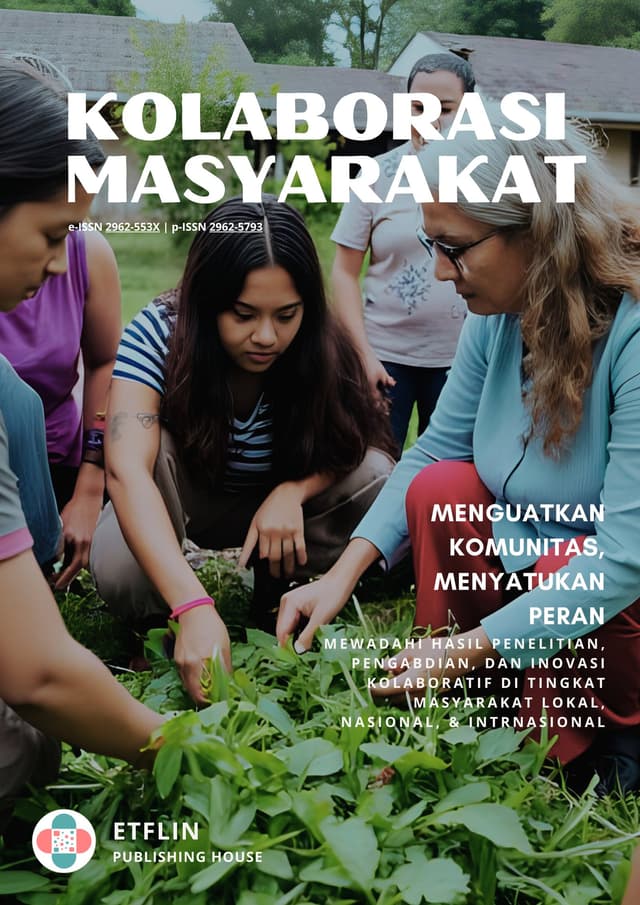
"Kolaborasi Masyarakat" merujuk pada proses atau praktek kerjasama dan interaksi antara berbagai pihak atau kelompok dalam suatu masyarakat. Ini melibatkan penggabungan sumber daya, pengetahuan, keterampilan, dan upaya untuk mencapai tujuan bersama atau memecahkan masalah yang dihadapi oleh masyarakat tersebut. Kolaborasi masyarakat dapat terjadi di berbagai tingkatan, termasuk tingkat lokal, regional, nasional, dan internasional. Berdasarkan ruang lingkup tersebut, Kolaborasi Masyarakat menerbitkan artikel dengan jenis riset, review, wawasan publik, surat untuk editor/letter to editor, dan opini/perspektif ahli. Jurnal ini terafiliasi dengan Fakultas Farmasi, Universitas Islam Sultan Agung.