Sciences of Pharmacy
Journal Key Facts
Publishing Fee (APC)
IDR 1,100,000
Open Access License
CC BY 4.0
Language
English

Publishing Fee (APC)
IDR 1,100,000
Open Access License
CC BY 4.0
Language
English
Showing 5 Articles

Recky Patala, Viani Anggi
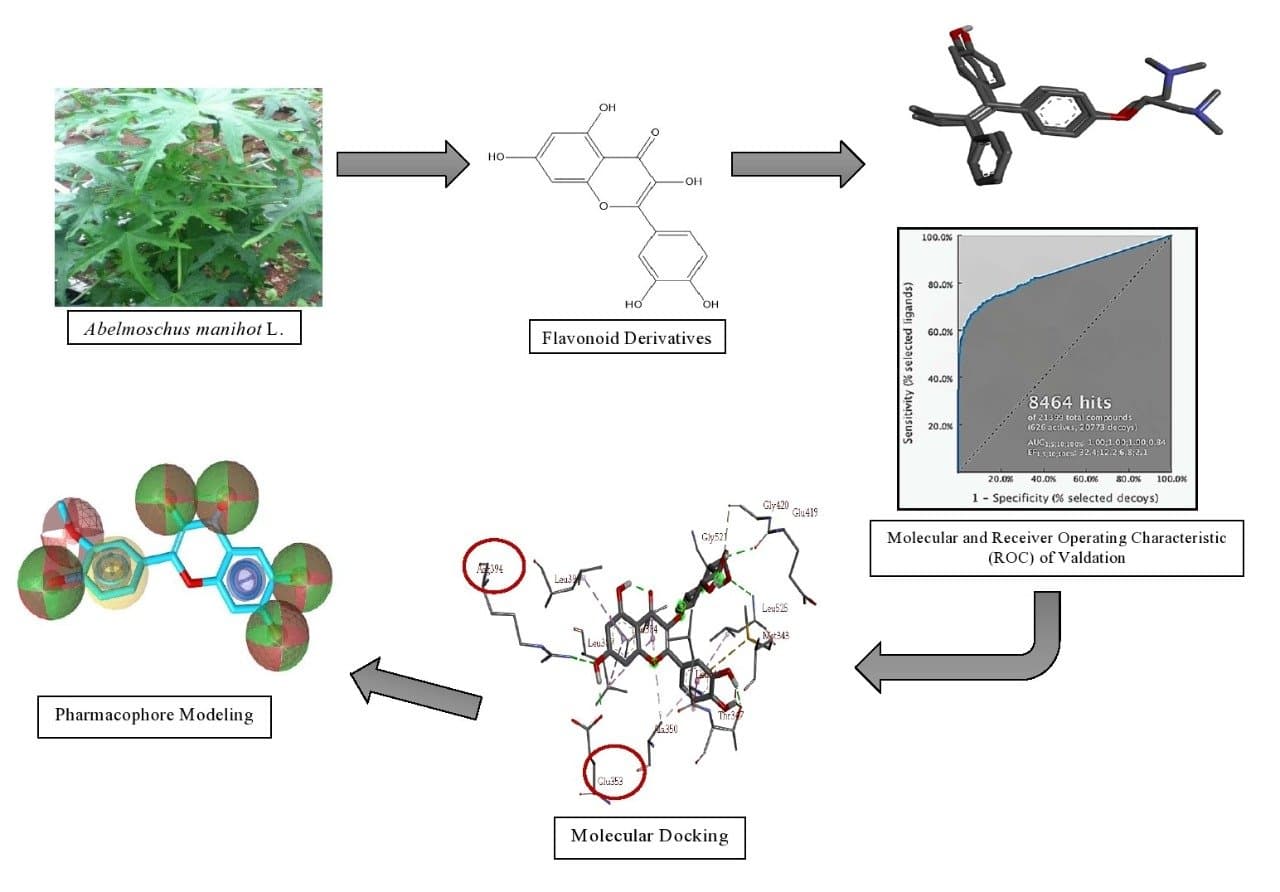
Tamoxifen is the most commonly used anti-estrogen adjuvant therapy for estrogen receptor-positive breast cancer. However, it is associated with an increased risk of some serious side effects, such as uterine cancer, stroke, and pulmonary embolism. The flavonoid compounds in the leaves of A. manihot inhibited the growth of 4T1 breast cancer cells at a CTC50 concentration of 185.06 μg/ml. Therefore, this study aims to examine the molecular interactions and pharmacophore modeling based on the interaction of 4-OHT with human ER, followed by the molecular docking of the flavonoid derivatives with human ERα. The molecular docking simulations and 3D structure-based pharmacophore models were used to identify the molecular interactions of flavonoid derivatives in A. manihot on estrogen receptors (ERα) (PDB ID: 3ERT). The results showed that the binding energies of the flavonoid derivatives in isorhamnetin and isoquercitrin were -8.68 kcal/mol and -8.75 kcal/mol, respectively. This compound also interacted with Arg394 and Glu353 important amino acid residues in the ERα-binding pocket. Meanwhile, the pharmacophore fit scores of isorhamnetin and isoquercitrin were 82.36% and 84.91%, respectively. The flavonoid derivatives in A. manihot had pharmacophore fit resulting from the 4-OHT complex with ER, and therefore they had potential as ERα antagonists. Out of the 10 flavonoid derivatives, isorhamnetin and isoquercitrin showed the best docking scores and could be used as candidates for new anti-breast cancer drugs with antagonistic activity against ERα.
Sciences of Pharmacy
Christy Putri Tari, Octaviana Maria Simbolon, Maria Elvina Tresia Butar-butar
Mixing intravenous preparation, especially in patients' intensive care unit (ICU) at the hospital, requires special attention on their higher medication errors, such as nosocomial infection and incompatibility drugs. The personnel, facilities, infrastructure, and mixing process must be carefully considered when preparing sterile mixtures. This study aims to calculate the percentage of suitability for the mixing process for intravenous preparations based on the Basic Guidelines for Dispensing Sterile Preparations, Guidelines for Injectable and Cytostatic Drugs in 2009, and the Handbook of Injectable Drugs Edition 16th for Intensive Care Unit (ICU) patients at the hospital “X” Samarinda. The research is descriptive research using sheets of observational data collection. The research subjects are mixing facilities, infrastructure, and procedures. We found as many as 215 processes of mixing intravenous preparations in the ICU, showing that nurses carried out 100% of compounding, 100% of the infrastructure did not have a clean room, LAF, and pass box, 53% carried out the mixing process according to procedures, and physical quality tests. Drug preparations follow the Handbook of Injectable Drugs Edition 16th. The preparations produced are clear and free of foreign particles.
Sciences of Pharmacy
Dwi Ayu Riningsih, Octaviana Maria Simbolon, Maria Elvina Tresia Butar-butar
Compatibility is one of the quality characteristics of intravenous (IV) preparations that influences the effectiveness of patient therapy in the intensive care Unit (ICU). This study aimed to determine the compatibility profile of IV medication formulations given to ICU patients. This prospective observational research was undertaken on patients in the ICU of a private hospital in Samarinda. The data on the intravenous combination of drugs were compared in this study utilizing the ASHP Injectable Drug Information literature 21st edition, Injectable drug guide, and Manual Book. Injectable Drug Mixing was published in 2009 as a resource for determining the compatibility of intravenous formulations. Using certain criteria, combinations of intravenous medicines and their solvents are classed as compatible (C), incompatible (I), and unknown (U). The ICU had 25 patients, 15 of whom were male, and 10 of them were female. There is no mixing of drug compounds containing incompatible solvents. All drugs were carried out with 100% compatible solvents. The limited information related to the compatibility and stability of these intravenous preparations encourages continuous monitoring of the patient's condition and drug levels.
Sciences of Pharmacy
Ainun Jariya, Andi Atirah Masyita, Ririen Hardani
Self-medication, the act of treating oneself without a doctor's prescription, carries inherent risks, as evidenced by the substantial 85.85% engagement in this practice among Central Sulawesi residents in 2021, according to the Indonesia Central Bureau of Statistics. This study, conducted in Tondo Village from August to November 2021 with a sample of 386 respondents, aimed to illuminate the characteristics of those partaking in self-medication. Noteworthy findings included a majority of female respondents (52.3%), aged 26-35 (24.4%), engaged in household work (31.1%), and with a high school education background (46.4%). Common minor illnesses addressed through self-medication encompassed fever (15.54%), ulcers (7.46%), coughs (15.54%), flu (18.91%), diarrhea (2.85%), headaches (1.30%), and allergies (0.78%). Examining over-the-counter (OTC) and OTC limited medicines, prevalent choices included paracetamol for fever (33.16%), antacids for ulcers (75.70%), Komix® for coughs (28.8%), Mixagrib® for flu (36.99%), Entrostop® for diarrhea (70.00%), Ibuprofen for headaches (100%), and CTM for allergies (100%), with 61.46% procured from pharmacies or drug stores. The selection of medications often stemmed from personal or familial usage history (84.46%), and 47.15% opted for self-medication to economize on treatment costs. Encouragingly, the study found that 75.09% of respondents exhibited good knowledge regarding the use of OTC and OTC-limited drugs for self-medication, underscoring the importance of ongoing education and awareness for responsible self-medication practices in the community.
Sciences of Pharmacy

Jessy Amalia Pratama Beta, Octaviana Maria Simbolon, Maria Elvina Tresia Butar-butar
Gangrene is one of the complications of diabetes mellitus. Along with the rising prevalence of diabetes mellitus (DM), the prevalence of gangrene and necrosis manifestations such as ulcers and infections will ascend. The selection of appropriate antibiotics is critical in infection therapy. Inappropriate use of antibiotics will result in antibiotic resistance. Therefore, this research aims to overview demographic, clinical characteristics, antibiotic use profiles, and antibiotic-related problems for DM patients with gangrene at the Abdoel Wahab Sjahranie Samarinda Hospital. The study was retrospective research and was conducted in July-December 2021. Twenty-one patients met the inclusion criteria, and demographic data showed that most patients were men 57% (n=11), and most age was 39-59 years (57%, n=12). The longest period of suffering from gangrene was 6-10 years (14%, n=3). The most common length of hospitalization was 8-14 days, as reported by 52 percent (n=11) of patients, and the most common duration of antibiotic use was ten days, as reported by 86 percent (n=18) of patients. A single-used antibiotic was ceftriaxone (19%, n=4) patients. The most used antibiotic combination was ceftriaxone and metronidazole (81%, n=17). Fourteen patients used antibiotics appropriately in dosage, route, and frequency. Four patients were unsuitable for the benefit of antibiotics in terms of antibiotic type, and three patients were unsuitable for antibiotic use in terms of duration of administration.
Sciences of Pharmacy
Sciences of Pharmacy (SciPhar) is an international, peer-reviewed open-access journal of pharmacy published by ETFLIN. We offer a platform and place for researchers and intellectuals, especially the youth, to share their insights and works. SciPhar accepts original article, reviews, mini-review, book-review, technical note, case report, case series, clinical trial, opinion/perspective, conference proceeding, and pictorial essay. Author may submit or suggest another type of scientific manuscript. Sciphar publishes 4 issues a year. Sciences of Pharmacy is affiliated with Faculty of Pharmacy, Universitas Islam Sultan Agung.